
 Newsletter Signup
Stay informed with the
NEW Casino City Times newsletter! Related Links
Related News
Recent Articles
Best of Gary Trask
|
Gaming Guru
  Gina Fiore's "Advantage Player" is no ordinary gambling book14 September 2026
Keough, the granddaughter of Elvis Presley and the Emmy-nominated star of "Daisy Jones & The Six," was there as the "big player." The woman signaling what to bet, from across the table, without appearing to say anything at all, was Gina Fiore. 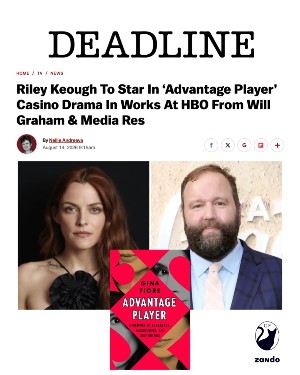 Emmy-nominated actress Riley Keough will portray Gina Fiore in an upcoming drama about casino advantage play. "She got a taste of it," Fiore said. "It was so much fun. She had a blast." That is a very Gina Fiore way to describe handing an Emmy nominee a stack of chips and telling her when to bet on a card the dealer wasn't supposed to be showing. Fiore's memoir, "Advantage Player: A Memoir of Blackjack, Backrooms, and Beginnings," covers the life Keough will be playing. It comes out 27 October from Gillian Flynn Books. I read most of the gambling books that come across my desk, so when I settled in and opened an advance copy of "Advantage Player," I went in expecting just that. What I didn't expect was how heavy her story would sit with me. As a father of three grown kids, the chapters about a young girl who learned to talk to debt collectors from a script, a woman who went years before anyone put a name to the illness she was dealing with, and a mother standing in a courtroom defending her right to raise her son are the ones I kept thinking about after I put the bookmark in and set it down. But before getting to any of that, I should explain what Fiore actually did for 24 years. Advantage players look for weaknesses in the games casinos offer and then exploit them until the math tips the other way. Card counting is the version everybody knows, mostly because of movies like "21," which was inspired by the best-selling book, "Bringing Down The House." Fiore did that too, but her real specialty was hole carding, which does not require a head for numbers so much as a willingness to stare. The dealer's face-down card is supposed to stay face-down until everyone at the table has acted. Some dealers are sloppier than others. Find one of them, learn to catch the flash, and you are no longer playing against the house. The house is playing against you. None of it is illegal. Casinos hate it anyway, and in casino towns, so does law enforcement. Over more than two decades, Fiore was backroomed, chased, and had $97,000 seized by federal agents in an Atlanta airport. Her name is on a U.S. Supreme Court decision, Walden v. Fiore, which she lost and which first-year law students now study. Kirkus called "Advantage Player" a "morally challenging personal history." Fiore does not mind the label. "I think it's just being in the casinos and taking advantage of their weaknesses," she said. "I think some people think that sounds like cheating." Is it? "There is zero cheating," she said. "But to a non-gambler, or someone who's completely unfamiliar, it's like, 'What? You went in there and did that? That's not legal.'" The boring part Hole carding sounds like a heist. It is mostly a walking job. Fiore estimates that one dealer in every 250 or 300 accidentally exposes a hole card. That is the whole business. One in 300. Everything else is strolling in and out of casinos, walking the floor, searching for opportunities. "I was in the casino all the time looking at all the dealers," she said. "That was it. And I would have lists. On paper, I had lists of the dealers." Ask her to describe a typical day, and you get something closer to a shift schedule at a job nobody wants. "If I was in Vegas, I had a hit list of dealers. I would wake up and start on the day shift, so at noon, I'd go to the places I know have dealers. I'd drive to the Orleans; I have a dealer there. They're not working. And then I have a dealer at, like, Harrah's; I go to Harrah's. They're not working. "And then I would spend the rest of the day walking up and down the Strip, in and out, and then the other side of the Strip. And then you might not find a game, and then swing shift comes on. You go to Bally's and check your dealer. You go to Caesars, they're not on, and then you spend the entire night just walking around or driving around looking for games. That is your whole day." Sixteen-hour days, she said. All the time. "It's very boring." She still has the paper lists with meticulous details, by the way. She used to carry them in her bag, which she now acknowledges was not the smartest thing a person could do. "If I get backroomed, they get my list of dealers." The one-in-300 figure is an average, not a rule, and the distribution is what makes it workable. She might find two exploitable dealers at Caesars Palace and none at Excalibur Hotel and Casino. She once found five at the Taj in Atlantic City while the rest of the city gave her nothing. And she does not think the number has changed much, even now, with fewer live tables and more automatic shufflers. "Probably the same," she said. "Especially because on shoes and stuff they flash their hole card. It still happens." Gene, in the rain The turning point in the book, and perhaps in Fiore's life, came on a day it was pouring.  Gina Fiore estimates that one dealer in every 250 or 300 accidentally exposes a hole card. Fiore was already working as a dealer in Las Vegas when she decided to try for a job at the new Agua Caliente Palm Springs. One day, in the pouring rain, she drove out to apply. The first person she ran into inside the casino was the man whose job it was to hire dealers. His name was Gene. She handed him her resume. He hired her on the spot. That job is why the rest of it happened. Advantage play is an edge measured in fractions, which means you need a bankroll deep enough to absorb months of bad luck. Fiore made hers dealing cards to other people. I asked her what would have happened had Gene been at lunch that day. "I was so lucky," she said. "I think I would have stayed in Vegas dealing. I would have found card counting. I think I would have done all of those things. But I wouldn't have been successful as fast, because I wouldn't have had the money. Dealing, I made so much money, so I could take swings and build a big bankroll. It would have definitely taken me longer, for sure." She used Gene's real name in the book, on purpose. "I hope somebody reads it and is like, 'Wait, I know that guy.'" Fiore writes that controlling optics in a casino is an underrated skill, and when you ask her to break it down, none of it sounds complicated. That is sort of the point. Stay at a table after the good game is over and keep playing on the square, because why would anyone with an edge stick around? Be visible in a casino on a night when there is no play. Sit at a slot machine that clearly has no edge and put money through it. "Or I'd go to the table with a slot ticket," she said. "That's always a great move. With a $2 slot ticket, because no hole carder's playing slots." Most advantage players, in her experience, do not bother. "No, they just go and find their game. They look around, and then they walk out. But I didn't have anything else. I always just said to myself, be good at your job. And it's those little, subtle things that make you a great advantage player." The part that isn't about cards Fiore lived in eight different homes before she turned eight. Her family hunted down new Domino's openings for the free slices. Her mother, who dealt at the Horseshoe, is the one who first told her she would be good at counting cards, years before her mother's own gambling problem surfaced. She has since buried both of her parents, and neither death was simple. Her mother, the one she resented most of her life, became the grandmother her son adored. "She was great. She was awesome," Fiore said. "My son only knows her as a great grandma. I don't tell him, 'Your grandmother did these things to me.'" They still visit the cemetery together and eat dessert there. Her father is prominent in the book as well, mostly through two objects. When he died, Fiore cleaned out his closet and gave away nearly everything, keeping a red shirt and the shoe shine kit he'd had her whole life. They have moved into the hallway closet of every place she has lived for the last 25 years. "It's just like he's there," she said. By 2009, Fiore had more money than she ever could have imagined, thanks to an AP team that was taking money out of casinos all over North America. She was not comfortable with it. There's a bit in the book about Waffle House, where she'd leave a hundred-dollar bill on the table and get out the door before the server saw it, because she was embarrassed by how much she was making and how easy it had become. Not what you expect from someone whose living came out of the casino's pocket. Then, just as you are celebrating the improbable success with her, it goes away. The real estate investments she had put everything into collapsed, and she also got involved with a person she declines to name in the book beyond an initial, "D." She is unusually direct about who was to blame. "I did it to myself. It was my own fault. It wasn't like this thing happened to me. I put all my money into real estate. I didn't diversify. I met this person who was pretty terrible. I made all of these decisions." Then she had to borrow money, which she called the "lowest point of my life," and not because of the money. "It is the worst to ask somebody to borrow money, especially when you've been so successful, and you don't want anyone to think you're not anymore. They think most gamblers who need to borrow money lost their money gambling. And it was like, no. I made really bad life decisions." She paid everyone back. She was becoming a mother at the time, and there was a custody fight, and in that fight the argument made against her was that she was, in her words, "a bipolar, degenerate gambler." In one of the most poignant moments of the book, Fiore writes, "Nothing feels as bad as the feeling of a failing mother." She kept her son. He is 10 and turns 11 later this month. Later in her life, Fiore was diagnosed with bipolar disorder and believes it emerged in high school. She is stable now, on daily medication, and open about all of it, which is not a small thing in an industry that trades on the word degenerate as a joke. What struck me was her conclusion about the career. 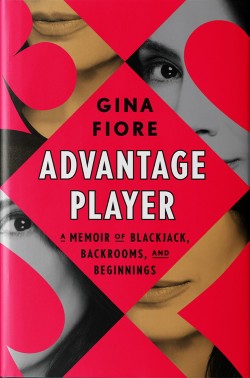 Advantage Player comes out October 27 from Gillian Flynn Books. "I wonder if I was stable, if I could have had a professional career. A lawyer sounds like something I would like, but there is no way I could go through the schooling for that. I think advantage play was the only thing I was going to be successful at." How so? "Because I got to be alone, walking, looking for dealers. I got to be eccentric, and it was masked, because all these people I was around were," she said, and then she trailed off. The sentence finishes itself. If you have spent any time around advantage players, you know exactly how it ends. "If you Google careers for someone who's bipolar, you'll get, like, librarian. All these non-stressful jobs. And I chose this very stressful one." Burning the boats Roxy Roxborough spent two decades setting the opening lines for Nevada's sportsbooks and wrote one of the first real books about the business. So when her good friend and first-ballot Sports Betting Hall of Famer told Fiore she could not write a good book, she had reason to listen. "I love Roxy, but he told me, 'You can't write a good book because you have a son,'" Fiore said. "He was just straight and told me that. And I know what he meant." He was not being cruel. He was being accurate about the constraint. Fiore had to show, not tell, when it came to her child's father, because her son would read this someday. "I couldn't call him names. I had to just show these things that happened." Her approach worked. Roxy was wrong. Having a son didn't cost Fiore the book. It's what gave it a spine. "Advantage Player" is a gambling book the way "Moneyball" is a baseball book, which is to say it's the rare one you'd happily hand to someone who has never placed a bet. Fiore has told her son he cannot read it until he is 26. She knows that won't hold. She plans to bring him to one book event, a gambling-focused one, where the personal material will not come up. "I hope he thinks I'm cool. Or that what I've done is, like, interesting." Getting the book published took roughly 106 agents saying no across two rounds of querying, starting around 2017. What finally worked was no query at all. A woman at Tribeca saw the documentary about Fiore's life, liked it, and made an introduction. Along the way, Fiore put her own face on Twitter for the first time, after appearing on David Hill's podcast at The Ringer, ending 20-plus years of deliberate anonymity. For most of her career, the blackjack world knew her only as Miss Brown, the handle she used on message boards. Plenty of people who have known her for years still call her that, or just MB. "I have to burn the boats if I want to go to entertainment," she said. Still looking These days Fiore is mostly online. Some sports betting, some sweepstakes casinos, all of it easier to fit around a son whose school day starts at 6:30 in the morning. She can walk into a casino, but she stays out of the pit because she wants to eat dinner without being asked to leave. There is no green light yet on the Keough project and no timetable she can share. What she does have is a Twitter feed full of prediction markets and the accompanying case of what she describes, cheerfully, as off-the-charts FOMO. "I have to block it out," she said. "I have zero time to dedicate to any of that." And there is one other thing she cannot switch off, which she mentioned almost in passing, and which I have not been able to stop thinking about since. "Even when I walk in the casino now, I can't not look. I just have to look. I'll be walking my son to the movies, and I have to just..." Twenty-four years in, off the floor and out of the pit, on her way to a movie with a fifth grader. She quit. She just can't stop working. "Advantage Player: A Memoir of Blackjack, Backrooms, and Beginnings" is out Oct. 27 from Gillian Flynn Books and is available for preorder now.
Gina Fiore's "Advantage Player" is no ordinary gambling book
is republished from Online.CasinoCity.com.
Related Links
Related News
Recent Articles
Best of Gary Trask
Gary Trask |
Gary Trask |