
 Newsletter Signup
Stay informed with the
NEW Casino City Times newsletter! Related Links
Related News
Recent Articles
Best of Gary Trask
|
Gaming Guru
  10 questions with the voice of the WSOP, Lon McEachern3 August 2026
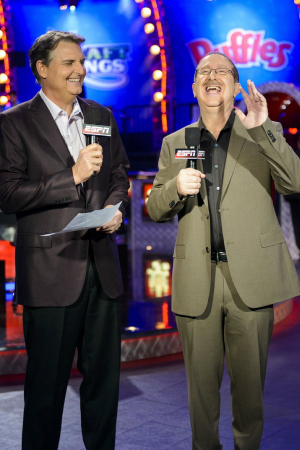 The voices of the World Series of Poker, Lon McEachern and Norman Chad. That matters more than the network logo suggests. ESPN and the World Series of Poker built each other. It started with seven hours of coverage in 2003 and a guy from a $39 satellite named Chris Moneymaker. Lon McEachern has been the voice of every Main Event since. Except one. McEachern and his long-time broadcasting partner, the estimable Norman Chad, sat out the 2025 Main Event livestream entirely. Chad called it a gap year. For McEachern it was a year of not knowing. "I wasn't quite sure what to expect last year," he told me. "There was quite a bit of uncertainty, and uncertainty in any profession, at any moment in life, is really the worst thing you can have. If you're riding a bike and you're not sure what the car in front of you is going to do, that's not a good feeling." A year later, McEachern is back, on a new deal, on the network he first appeared on in 1993, calling a final table with 22-year-old chip leader Lucas Jumalon sitting behind 129 big blinds. In preparation for the final table, I caught up with McEachern, who I first interviewed back in 2008 at the Rio Hotel & Casino, after bumping into him as he was walking the Amazon Ballroom taking notes on players. Eighteen years and numerous conversations later, we covered his role over the next three nights, how the layoff has affected the nine players, the newly installed and controversial shot clock, and 24 years of having his voice attached to poker's biggest moments. 10. Let's start with the basics. What exactly is your role at the Main Event final table this week? Norman and I are involved in both the live and taped shows. Nick [Schulman] and Ali [Nejad] will be doing the main play-by-play of the final table. Norman and I will be present to open each show, and then they'll come to us for some in-game stuff, big picture insight, and anything we notice. That'll happen all three nights. I don't know how many times we pop in. And I'm hearing there's some desire for us to be in the booth at some point during the last night with Nick and Ali, just to get us all together. Then we'll be doing the voice on all the posted shows. Those have to be produced right away, so we’ll be in the studio on Saturday voicing those. 9. Do you prefer the live broadcast or the taped/can version? I love doing both. I've always loved live TV, the immediacy of it, the unexpected nature of it, the chance to have to turn on a dime. For a broadcaster, it's thrilling. The taped shows are obviously more crafted. There are so many bridges that have to be built between hands, where you provide the audience some perspective on where we've been and what's happened. That's a different craft all in itself, and there's more storytelling in it. I'll say this too. As I get longer in the tooth in this business, it's always nice to do a live show and then be done. In poker, that's rarely the case. 8. You've said before that you and Norman aren't GTO announcers. Is that why the livestream went to somebody else this summer? The livestream audience wants every hand. It's a smaller group, and they want to be talked to at the level at which they play poker. That's just not the path Norman and I have taken. (WSOP CEO) Ty Stewart, who runs the whole show, has often said we're there for the ESPN mainstream audience. If you want to watch a live event, you have to be proactive. You have to know where to find it, you have to pay to find it, and you have to be willing to sit there for hours on end. Those are two different audiences, and I think they're trying to speak to both. We're not shy about saying we're not GTO poker announcers, and I'm fine with that. I want the audience to have the best experience, and if this is the way to do it, then good. 7. And it's ESPN again. What does that feel like after a year off? I've been with them forever. My first show ever was back in 1993. I owned a production company, created a show, and needed an announcer. I knew it was going to be on ESPN, so I hired myself. That was my first show, hiring myself. That led to a lot of great things over the years with ESPN in a lot of different sports. So yeah, it feels like being back home. And I should say this about last year. Ty Stewart and the GGPoker folks and the WSOP stepped up and wanted to do right by us. They acknowledged whatever boost we've been able to give the game through the years, and to them as a company. They showed their appreciation, and they signed us to a new deal this year. I'm thrilled they did. 6. There's a three-week gap between the setting of this final table and the playing of it. You and I both lived through the November Nine Era. Is this the same idea? I was always a big fan of the November Nine, and I never got a good read on whether that put me in the majority or the minority, because I heard both sides. But I came down on the side that it was terrific for the players. A lot of players said it was terrible, that it interrupted the flow. It's nine guys out of 10,000. From a physical standpoint, a fatigue standpoint, a marketing standpoint, there were a lot of good points to it. And the fans who watched didn't get spoiled. This is like a Reader's Digest version of the November Nine. You get the shows leading up to the final table; even though there aren't as many of them, you see how everything progressed, and then you get to live the final table a few weeks later. I'm a big fan of it. I have no problem with it at all. The short turnaround is a little awkward for the international players. We've got a couple of Canadians, a French guy and a guy from Cyprus. They'll come back for a million bucks, I’m sure. 5. Another notable change that happened this summer was the shot clock. Players have 20 seconds to make a decision, six 30-second extensions for the whole tournament, and if you run out your hand is dead. The WSOP dropped it in on Day 7 of a Main Event that had already been running a week, the first time it has ever used one. Was this the right call? The stalling has been pretty egregious in isolated incidents, and overall people take a long time. So I understand it. But I think the clock is a little short. I was playing a circuit event and talking to some people, and as far as they know, the shot clock is coming back, so I assume it'll be the same clock. Maybe they'll get more time extensions. It affected decision-making for sure, especially for players who had never used one, because they're not high roller guys. They probably learned a lot, and probably wish they'd had a few more seconds. Instead of 20 or 30, maybe go 30 or 45 minimum. The mechanics were fine. The dealers were already used to the clock from high roller events, so that all worked. My other issue is that it kind of ruins the table talk, which is sometimes really enjoyable to watch. We always love hearing from the table. Now everybody's walking on eggshells, because if a guy has 30 seconds to make a decision for a million dollars, you want to give him some quiet. 4. Twenty-two days off. What does that actually do to these nine players? It's a real personal thing. You can't put a blanket over a group of people and say this is what's going to happen to them. Greg [Mueller] told me he's using the time to lose 20 pounds because he looks fat on TV. Lucas [Jumalon] is taking it all in stride, trying to realize the moment and not get overwhelmed by it. I'm sure they're all studying situations, though I've never been in a position where I thought you could get a lot out of studying individuals, because every poker player knows you can't be predictable. Whatever they've been doing on camera might be exactly what they want to get away from. Then you've got a guy like Evagoras Evagorou, the optician from Cyprus. I don't know what his motivation is. Maybe he tries to ladder up. They're all dreaming about $10 million. I guarantee you that. The biggest thing for all of them is trying not to be overwhelmed by the moment. 3. Who's the most dangerous player at that table? Mueller. He's super driven, and he's been through the wars, though I wouldn't say he's as battle-tested recently, because he just hasn't played that much. So he's riding a lot of instinct. But he's got good help too. He told me he's getting help from his good buddy [Shawn Buchanan, also from Canada], who's giving him the GTO side of things. So Greg has feet on both rails, his own instincts and this newer form of the game that he's taken to heart and is comfortable with, and that he trusts when he's at the table. That could be dangerous.
2. Jumalon has 129 big blinds and 35% of the chips in play. If he wins, he's the second-youngest champion behind Joe Cada, whose win you called in 2009. What do you make of him? It's funny, because Lucas does point toward Joe as somebody he'd like to emulate. Not just the winning, but everything after. I think he's a similar type of player in the amount of skill he has. Really skillful, really smart. He has a good support group, and he looks to his dad a lot, who's very supportive and keeps him grounded. Everything I've heard about Lucas is how much he considers everything around him, that he's a considerate person. In his early days in poker, he poured his heart into it, and his heart got broken a lot, and that's a learning experience you can't get any other way. He's spent time in the seat, and he can see what's coming. There are little clues here and there that you only pick up if you've been there before, and I think he's that type of player. And with that chip stack, if you look at it historically, it's almost guaranteed third-place money. We've seen blowups. But if he takes that to heart, I think it might actually free him up to do the right thing in a tough spot, instead of thinking, well, maybe I'll just call. It lets him make a better decision in those moments. I'm not making predictions. But I wouldn't sell him short because of his age at all. 1. You told me in 2021 that you had the best seat in the house and the best job in the world. Still true? Absolutely. And it's still very weird for me when people write things about me, or recognize me walking through, or make drawings, or that fake tattoo I wore for Norman. It's humbling, and it's thrilling, and I'm appreciative of all of it. I don't think it's gone to my head, and I still pinch myself that I'm doing this. If you asked me for one moment off the highlight reel, it's hard to turn down the Moneymaker moment. But I really enjoyed the journey George Holmes took. The bad beats Matt Affleck took stand out, and I feel bad about that one, because I golf with Matt every May, and every year the worst-beat-in-World-Series-history lists come out, and he's at the top of them. Darvin Moon, that was a blast. They're all classics. When somebody plays back some of the greatest or the worst moments in poker, our voices pop up in there. That still puts a smile on my face. The WSOP $10,000 Main Event final table resumes Monday at 9 p.m. ET on ESPN2. Monday's broadcast runs to midnight and plays down to six. Play returns Tuesday at 9 p.m. to midnight on ESPN, and plays down to three. On Wednesday, the broadcast runs 10:30 p.m. to 1:30 a.m. on ESPN, and plays to a winner, who will take home the Main Event bracelet and $10 million
10 questions with the voice of the WSOP, Lon McEachern
is republished from CasinoVendors.com.
Related Links
Related News
Recent Articles
Best of Gary Trask
Gary Trask |
Gary Trask |